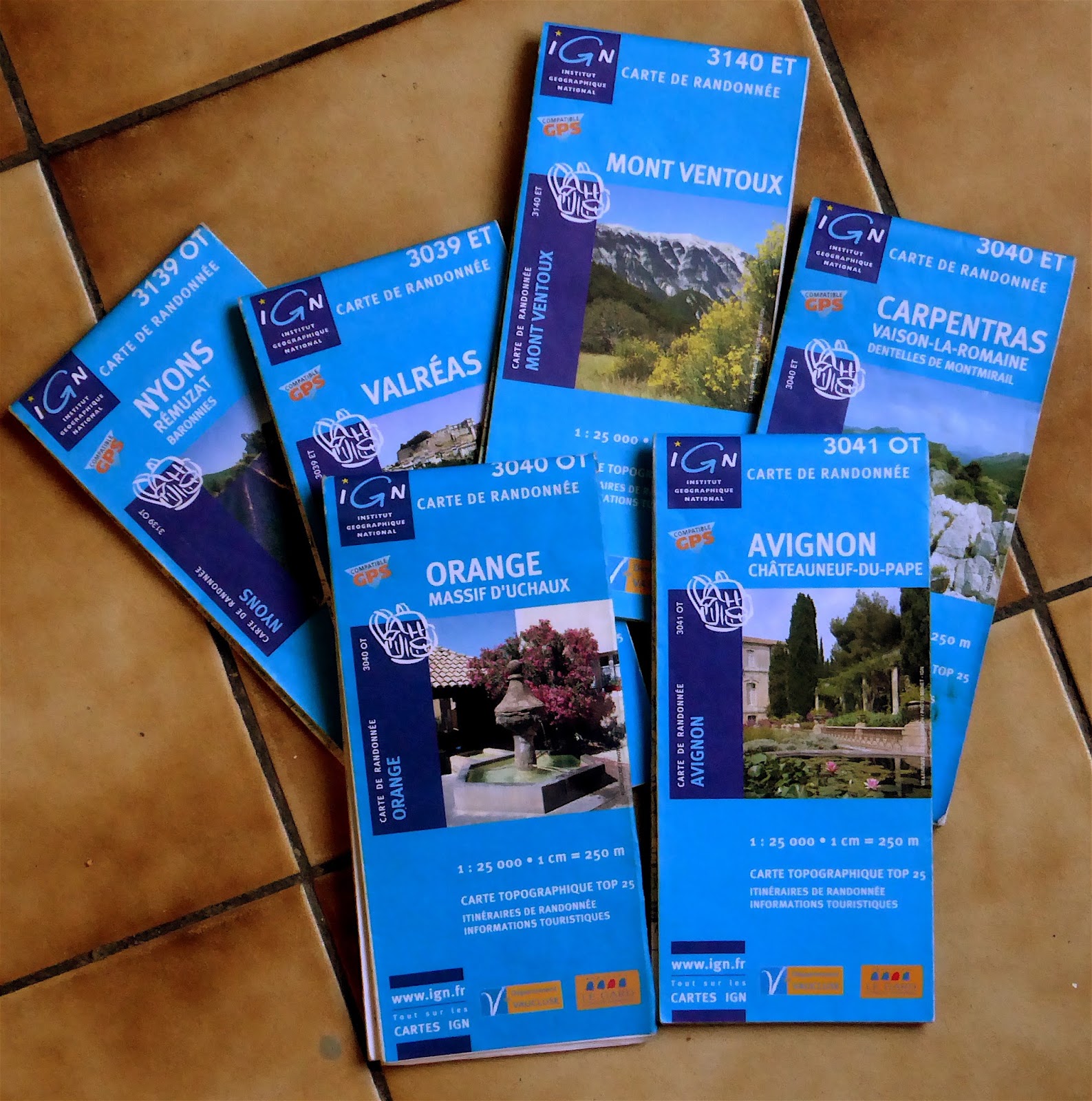
A while back the line that caught our imagination was Le Petit Train, the long closed metre gauge railway that ran from Orange SNCF to Buis-les-Baronnies, passing through Sablet en route.

We spent several days visiting and walking the route of this lost railway (closed and lifted in the fifties), finding the clues that still exist as to where it was laid: roads that have adopted the route, crossing keepers' houses, the surviving stations now serving as houses, depots and, in one case, a school, two tunnels – one with a road through it, the other, a wine store – viaducts, bridges and culverts. In some places the route is clear, elsewhere the railway has completely disappeared, for example under Orange military airfield infrastructure, or under new housing. But the careful seeking of the clues and indicators was intriguing and rewarding, helping us to enjoy the landscape around here in a very focussed and singular manner. And poignantly we even found a short section of track still in place at the entrance to one of the two tunnels on the route.
A beautiful railway then, that lasted less than forty years, still mourned by fans of slow rail travel through wonderful countryside. The fact is, if it had survived it would be coining it in as a tourist attraction now, although Vaison would have had to do something else for its ring road!

As far as we can tell the canal is not pumped although there a number of standby pumps along its length probably to restart syphons and flow after drought: there may be times when the water hardly makes it to the end. We shall check this out in the summer no doubt.
We have not done so very much to trace this canal, not as much as we did on Le Petit Train. The mapping shows it clearly but sometimes confuses: according to IGN the canal goes over our local river on an aqueduct but now we have found and demonstrated that the canal goes under. But it is really amazing, going about, just how often we cross it or some of its branches. Good too to see that it is regularly cleaned out and even repaired and strengthened in places. We haven't been to where the canal starts out, as yet, but we've inspected the biggest syphon, found tunnels, walked sections and visited the last sluice. Good fun, satisfying and calling for careful map use. And we have finally visited the crossing of the canal by the route of the Petit Train . . .
Ok, ok – you can do the whole lot now on the interweb from the comfort of your own fat arse, but where's the fun in that? Would we have had a close encounter with a great big green lizard, back here, on line? We are discovering for ourselves – that we are! Once again the paper map is the prompt.